User problem focused org charts
What if hierarchical organisation charts were replaced with a chain of who solves problems for who going from the CEO to the users.
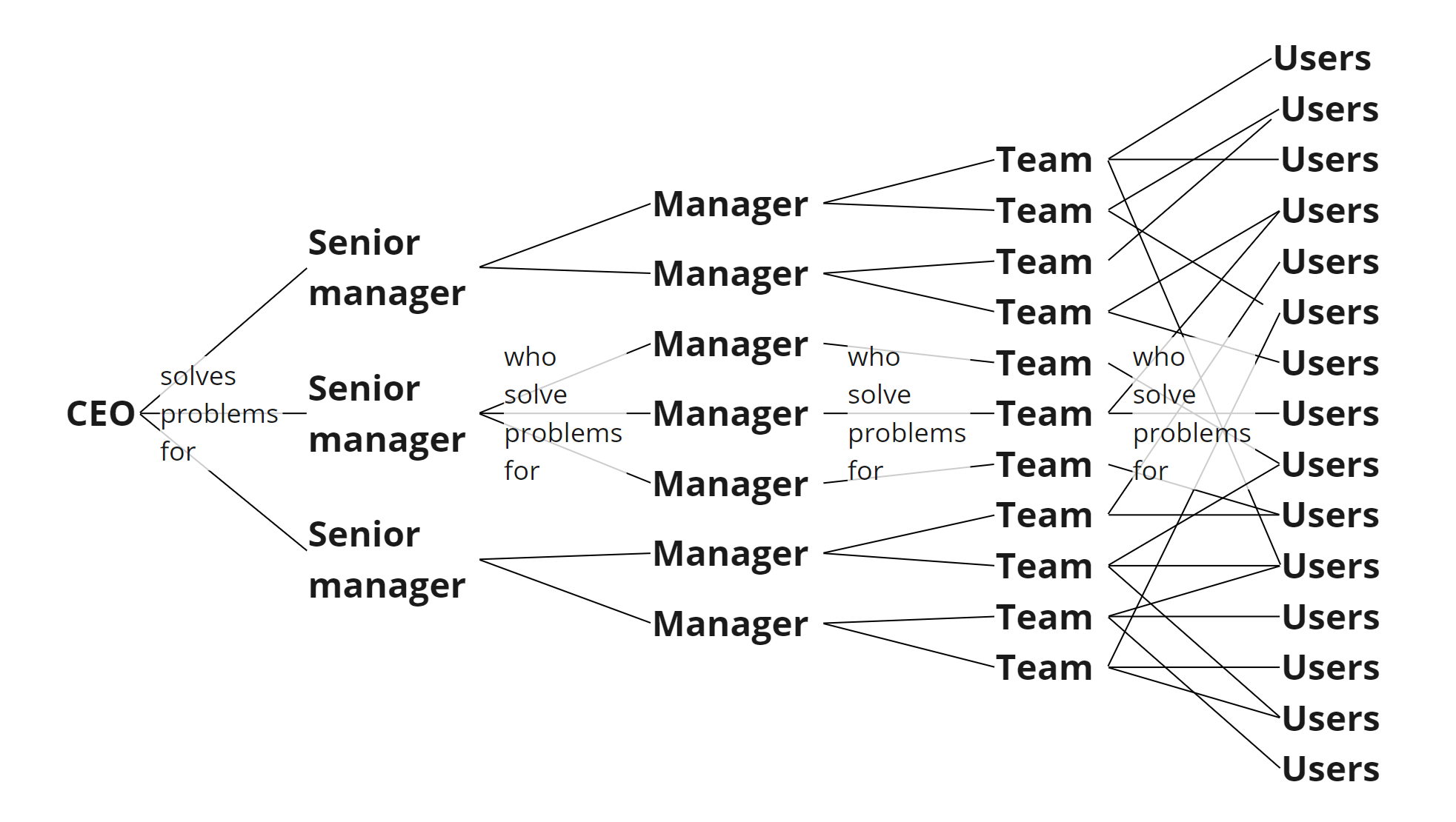
What if hierarchical organisation charts were replaced with a chain of who solves problems for who going from the CEO to the users.
Went for a walk on the beach and saw an old abandoned lighthouse.
Wrote and sent the 7th Irregular Ideas email newsletter.
Bought systemshiftingproduct.management domain name and pointed at the Google Doc.
Worked on the third future skills email.
The British Film Institute’s critics think Vertigo is the greatest movie of all time. Empire says it’s Lord of the rings. Time Out think 2001: A Space Odyssey is the best. But they’re all wrong. The greatest movie of all time is Dirty Dancing. It is unique. There is no other film like it. Vertigo is just a thriller, and there are lots of those. Lord of the rings is a fantasy adventure among other fantasy adventure films. 2001 is just another sci-fi movie.
But Dirty Dancing is in a genre of it’s own. It’s a musical without being a musical. It’s a romance that doesn’t shrink from the difficult realities of relationships. It’s a coming-of-age story that tackles social issues around class, wealth and privilege. It’s proudly feminist in how it treats abortion and women’s agency over their choices. There is no other movie that is so thought-provoking and challenging at the same time as being uplifting and life-affirming, and that makes it the greatest movie of all time. Nobody puts Dirty Dancing in the corner.
Gartner’s “Bimodal” IT model has taken the world of enterprise IT by storm. Gartner defines Bimodal IT as “the practice of managing two separate, coherent modes of IT delivery, one focused on stability and the other on agility.
https://continuousdelivery.com/2016/04/the-flaw-at-the-heart-of-bimodal-it/
Tried to focus on writing the third email for Future Skills but kept getting distracted by Twitter and other little ideas. Wondering if I should spend time trying to grow my number of followers, but to what end? Maybe with the Twitter Product Manager community in case I ever do write a book about systems-shifting product management. I’m just not sure anyone else would be interested in it as most of them seem focused on the day-to-day tactics of product management.
Follows you around the Internet tidying up after you. Unsubscribes you from emails you don’t open, requests your data be deleted from that website you bought from once five years ago, etc.
Photo of the week:
This week, I did:
I mapped user journeys specifically for evaluation purposes, and it got me thinking about whether and how the evaluation of programmes that aim to achieve considerable life changing outcomes can be part of feedback loops. Intuitively, it makes sense that small outcomes have small feedback loops and large outcomes have large feedback loops. But a few things to remember: the aggregation of lots of small outcomes doesn’t necessarily equate to a large outcome, evaluation can be linear and not feedback, and it’s easy to evaluate different things than those that might change the outcome.
And speaking of using feedback loops better, I presented the solution design work I’ve involved with to the developers for their feedback on the feasibility of the ideas. It was really useful and has meant I can creating two solution designs that are more right-sized for what they’ll need to achieve in different circumstances. Such is the benefit of sharing incomplete work early for fast feedback.
I did some more work on Future Skills emails. I complete the second email which is about fluency of ideas, the skill of coming up with lots of ideas quickly. I wrote this email far more quickly than the first so my hope that setting a template would make the content easier seems to be working. We’ll see for the next email which is about active learning. I still have a long way to go to create all of the emails but I think I’m going to focus on this for December rather than spreading my time across other projects like Systems-shifting product management and future.charity.
As it’s the end of November and beginning of December I did my monthly retro and delivery planning. My lesson from November was about how aiming for simplicity has lots of benefits. Complications slow down progress and drain motivation. In an attempt to make the most of this lesson I’m going to try to focus more time in December on just one project.
And I read:
More and more I think the solution to digital, remote, asynchronous working (DRAW, as I might start calling it) is going to be about how we mix and mesh different models, frameworks and practices. One of those things to figure out is how we measure the progress of work without having to be limited to a single way of working that provides consistency in reporting. Kanban metrics focus on how “cycle time that deals with the average amount of time taken for a task to move from start to finish. Improving cycle times by removing waste and blockers help to achieve improved results.”
Following on from completing the Humane Tech course, I read some stuff from Humane by Design and Ind.ie. The pyramid of technology that respects Human Rights, Human Efforts, Human Experience is interesting, and “resources that provides guidance for designing ethically humane digital products through patterns focused on user well-being” are really useful.
I read lots of stuff from Tiny Little Business, including The Durable Business Course.
I thought about this week:
Pieter Levels tweeted about shipping fast by building light which prompted me to think again about how I priortise the things I want to work on. I’ve tended to focus on things that interest my rather than things that might be of value to others. Honestly, even if I do figure out how to create a DAO charity, no one is even going to be interested let alone pay for it. The usual way creators figure what to build is to build for their kind of people. Developers build things for other developers. Remote content designers build things for other remote content designers. As a charity product manager there aren’t enough of us. I’m too niche. The answer, perhaps, is to find things that interest me and are useful to others.
I was thinking about autonomous teams and what it takes to get there, and how leadership works for high-performing autonomous teams. Teams have to have leadership. The ideal for autonomous teams is that the leadership exists within the team. For non-autonomous teams, leadership should come from outside the team, from above. But what happens when a team doesn’t have either. A team without leadership is an abandoned team, left to get on with things without direction or cohesion. I’ll probably write up these ideas into a blog post if I get time.
Or DRAW, for short. I’ve been thinking about some of the problems we’re all trying to figure out for effective digital, remote, asynchronous working. Things like communication, alignment, coordination of work, etc., all need to be revisited and reworked. Just applying the old ways isn’t going to work. It seems like there’s a good market size there but I stopped myself from buying the domain digital-remote-async.work. I should focus on finishing current projects rather than starting new ones.