Blockchain for charities, a talk by Rhodri Davies

Why should charities care about Blockchain?

  • Blockchain offers new ways for charities to achieve their mission.
  • Blockchain will change the way organisations operate.
  • Blockchain may create new problems to be addressed by charities

Charities don’t have the luxury of thinking they can get away without thinking about disruptive technology.

Charities need to understand the nature of the changes Blockchain will cause or become irrelevant.

Disruptive = doing stuff in a way that makes the old way obsolete.

Cryptocurrency & Blockchain Technology

Blockchain for charities, a talk by Rhodri Davies

Non-financial blockchain uses

Blockchain for charities, a talk by Rhodri Davies

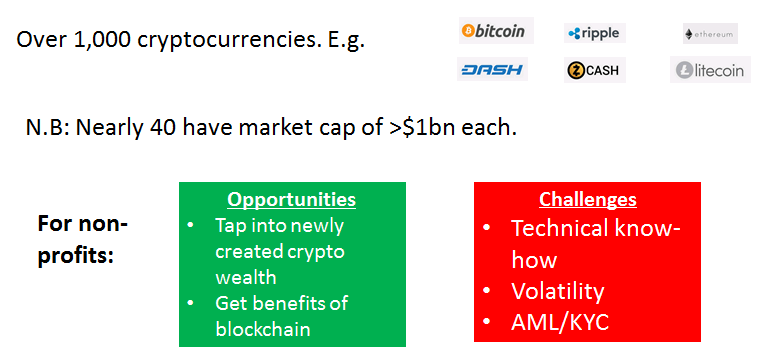
Cryptocurrency

What are the key feature of blockchain tech?

What does blockchain enable?

Civil Society Blockchain Possibilities (part 1)

Civil Society Blockchain Possibilities (part 2)

Weeknotes #96

What happened this week…

  • Discussed the public positioning of the chain of survival.
  • Mocked-up a page on the Online Shop for selling defibrillators.
  • Added 7 new greetings cards to the Online Shop.
  • Interviewed First Aiders about defibrillators in their workplaces.
  • User tested menu categories on the Online Shop.
  • Learned about a competitor’s sales process.
  • Requested images of people wearing items from the Online Shop for the new homepage.
  • Booked onto the iPos training course to support selling defibrillators logistics processes.
  • Discussed the Online Shop at Phase 1 of RMSP.
  • Prepared for a presentation about our plans for selling defibrillators.

Read this week…

Doing next week…

  • Holding the Accessories Team monthly meeting to discuss clothing rebuys.
  • Meeting to discuss evolving how we buy for our supporter range.
  • Putting together our Christmas Card Advertising plan.
  • Discussing stakeholder communication plans.
  • Gathering Christmas Card product information.
  • Meeting the new Web Applications Solution Architect.
  • Learning how to set up contact forms on the main website.
  • Discussing data protection for selling defibrillators.
  • Testing the new Magento 2 site.

Interesting stat of the week…

  • Comparing the first five months of this year to the same period last year, we’ve seen Conversion Rate increase by 42%. The greatest increase was 319% from Social traffic, then 57% increase from Referral traffic and a 37% increase from Organic traffic

In the not too distant future….

  • A ‘test and learn’ approach to new products on the Online Shop.

First Aid at Work Training

Completed First Aid at Work Training with St. John Ambulance.

The way the course is run has changed since the last time I did it. There seemed to be more of a dumbing-down of first aid techniques, perhaps in recognition that the majority of first aiders are unlikely to retain more complicated techniques and apply them correctly, and that making the course simpler means more people will do it. So, it’s better to have more people with less knowledge than fewer people with greater knowledge.

Talking about first aid, and the causes of injuries got me thinking about complacency again. I think complacency is the root cause of the majority of injuries; didn’t think driving fast would be a problem, didn’t think to check the smoke alarm batteries, didn’t think to look both ways before crossing the road, etc., etc.

Developing a mindset of planning ahead, figuring out what the right procedure is, and following it in a habitual way is the solution to complacency. Then its ok to not think about the thing that you would be complacent about because the procedure takes care of making you do the right thing.

Testing images for charities

A selection of our images and stock images were tested and this is a summary of some of the outcomes:

  • People look at facial expressions, especially mouths.
  • People facing towards the camera offer better impact and being able to see their eyes to gauge emotion is useful.
  • Images with a clear purpose resonated, for example seeing someone wearing a branded T-shirt helped better connect with a fundraising ask or gave that sense of wanting to help. People wanted to be able to visually identify a charity and will look for badges and logos.
  • When showing a survivor, provide clear visual clues such as scars from surgery.
  • Don’t use shots of people wearing high-fashion (really well-dressed people) as apparently this is off-putting.
  • Don’t show images that could bring people to do the opposite of what you want, e.g. someone eating chocolate when we would want them to abstain –we’re not good at processing negatives.
  • Show images with hope, not shame – people connect emotionally.
  • Staged images weren’t well received – such as a baby dressed up in a Santa outfit. People felt manipulated. There is a fine balance between making people feel bad about themselves, against tapping into emotion to prompt people to react and donate.
  • Images showing concern makes people want to take action, but with a medical image of someone with discomfort made people turn away.
  • Natural poses and settings make people identify and comes across as warm and genuine.
  • Selfies did not read well, as people in them did not comes across as connected to cause.
  • Everyday people were more relatable – not super-fit super models.
  • Moments at the end of the race and demonstrating a sense of achievement were well received (rather than mid-race, partway through ‘the struggle’).
  • Groups of people / crowds tested well.
  • Images of babies tested better than of older children to show a sense of urgency and to prompt donations, as did black and white photography.
  • Real (recognisable) medical equipment tested better than graphics – and even more so if in use in a realistic setting such as a hospital.
  • To demonstrate ‘money making a difference’ images of researchers tested better than images of survivors as the latter give the impression of helping ‘only one person’.
  • Showing several researchers working rather than a single researcher gave the impression that more was being achieved.

Digital Design Principles

10 design principles to help charities build better digital services:

  1. Start with user needs, and keep them involved
  2. Understand what’s out there first
  3. Build the right team
  4. Take small steps and learn as you go
  5. Build digital services, not websites
  6. Be inclusive
  7. Think about privacy and security
  8. Build for sustainability
  9. Collaborate and build partnerships
  10. Be open

From betterdigital.services

Weeknotes #95

Last week’s update…

What happened this week…

  • Documented finance processes for Selling Defibrillators.
  • Went to a GDPR webinar.
  • Had a meeting with our logistics supplier to discuss improving stock accuracy.
  • Reviewed the AX Test Plan.
  • Wrote user testing interview questions.
  • Events Chatbot went live.
  • Discussed stakeholder communication for the Selling Defibrillators project.

Read this week…

Doing next week…

  • Product development meeting with the Accessories Team.
  • Documenting the value proposition for Selling Defibrillators.
  • Finishing the new Supporter products range plan.
  • User research with First Aiders and Health & Safety Managers.
  • Signing off the designs for the new Online Shop.

Interesting stat of the week…

  • Comparing the Conversion Rate in May 2017 to May 2018, we’ve seen an increase by 50% from 3.9% to 5.9%

In the not too distant future….

  • Testing Magento 2.