Always start a side-project with a domain name

Always start a side-project with a domain name. Use it to help validate ideas in the short-term but get the benefits in the long-term as your project develops.

1 Redirect it to another website

  • Quick and easy to set up
  • Share the link and get brand awareness
  • Lose your brand once clicked

Example: ultimatedigital.tools redirects to a Gumroad page

2 Custom domain on a third-party platform

  • Get some functionality (e.g., email sign-up)
  • Keep your brand when clicked
  • Limited design and functionality

Example: futureskills.info uses a Mailerlite landing page.

3 Address for a website

  • Lots more functionality
  • Lots more control over design and branding
  • Costs more time and money

Example: rogerswannell.com uses WordPress.

As a project develops and needs more functionality you can move the domain name onto other platforms and take the brand awareness with you and any links will still work.

Whichever way your project goes, you keep the benefits of having used the same domain name throughout.

The reasoning behind the roadmap

There’s more to creating a product roadmap than putting boxes on a diagram. To create effective roadmaps you need to understand the logic that applies behind the boxes.

Product roadmapping uses deductive reasoning. It starts with a theory, sets a hypothesis, and then makes observations to prove or disprove the hypothesis, and so deduce conclusions from things proposed by the theory.

Products start with the ‘subjective theory of value‘. It states that value is determined by the importance an individual places on a good for the achievement of desired ends.

When we talk about products meeting user needs or outcomes, we’re talking about the subjective theory of value. It says users value meeting their needs more than they value the money the product costs, that’s why they pay.

Next we set hypotheses to test the theory. It could be ‘releasing new feature X will meet user need Y and users will pay Z for it’. We might show this on a roadmap as ‘Feature X’ but really we’re expressing the hypothesis.

When we measure how well that feature is performing we are conducting observations to prove or disprove the hypothesis. If we get feedback that the feature is meeting the need and that users are willing to pay for it, then we’ve proved our hypothesis correct.

We use deductive reasoning for roadmapping because it closely follows the path of logic and has advantages:

  1. Explains causal relationships between concepts and variables.
  2. Measures concepts quantitatively.
  3. Generalises findings to a certain extent.

Concepts are abstract ideas like ‘paying’ and a variable might be ‘price’. Deductive reasoning helps us understand the relationship between the price, which we can change, and the how likely users are to pay that price.

We can measure a concept like ‘paying’ quantitatively by observing how many users pay and how much they pay. This helps us understand the concept more objectively and build theory off of it.

Deductive approaches allow “reasoning from the general to the particular” (Pelissier, 2008) meaning that what we can link premises in the theory with conclusions from our observations.

So, roadmaps are more than just a diagram of features, they are a means to bring the discipline of deductive reasoning to product management and to express the hypotheses that we use to test theories.
Retrospective November 2021

Lesson of the month is ‘simplicity’. However big and complicated something is, pulling out the simplest small part of it is the fastest way to progress. Sometimes things like complicated just because they aren’t well coordinated. Simplification makes coordination easier too.

Contributing to the digital transformation of the charity sector

It’s been a interesting month of moving from definition to the development work. I always know that the transition is never straightforward and clean cut like all the models show but I still get slightly surprised by it. Project phases are an illusion.

I didn’t get onto the work I was expecting/hoping to do around the continuous improvement model for the product but I did progress the decision around the use of virtual meetings platform. And as always, I did lots of other things.

I resigned from my role at the Prince’s Trust and am joining RNID as a Product Lead.

Learning about innovation, technology, product and design

I’ve pretty much given up on the idea of innovat100n.com. FutureSkills.info is a more interesting idea with better defined audience and at least some idea for a potential marketing plan, and I’ve already made more progress than I ever did with writing a hundred essays about innovation.

I’ve enjoyed writing the Irregular Ideas newsletter for the past five weeks. Being a newsletter rather than blog posts adds some constraints which I think/hope are improving my writing and I like that it has a broad topic.

I didn’t add any more stiles as NFT’s. Just wasn’t a priority. It would be nice to get all of my stiles on Opensea but it’s very time-consuming I don’t know what I’ll do with them once they’re on there.

I did a bit of research into DAO’s for future.charity but not enough to really progress the idea. There is still something really interesting to explore there but it’s big and messy and amorphous and very uncertain.

I wrote quite a few blog posts for NoBloPoMo but not the full thirty I was intending too. I decided to refocus on other projects.

Didn’t do any work on Adjacencies and losing a bit of interest in it.

I finished the Foundations of Humane Technology course. I want to try to embed some of the stuff I learned in my product thinking so I might write a blog post about it as a way to start to collect together some thinking about humane tech.

I wrote weeknotes on schedule every week.

Leading an intentional life

My nomadic life along the coastline continued. The weather and dark evenings haven’t stopped me from visiting beautiful places each day.

Research on how charities approach innovation and new product development processes

Innovation is a challenge in the charity sector. Not only are charities stuck between constraints on funding innovation and the need to create new value and better ways of operating, but all of the innovation methodologies are aimed at commercial organisations. So, how do charities innovate? How do they take a good idea and create social good?

I interviewed four charities with innovation teams in order to try to find out. We discussed their innovation processes, their motivations for innovating and how they judge the success of innovations.

From an analysis of research I built a theory for innovation in charities and develop the ‘charity innovation model’ which plots the approach a charity takes towards innovation on a two-by-two matrix by assessing common characteristics in motivation to innovate, implementation of innovation process and the judging of innovation success to indicate whether the innovations produced are likely to be incremental or radical innovation and strategic or social innovation.

The research concludes that charities do not use their innovation teams to develop radical new solutions to tackle social issues which contributes to answering the question often raised about charity innovation; ‘if charities are innovating, why are there still so many social issues?’

The full research write-up is here.

Foundations of Humane Technology: the course all product managers should take

The Center for Human Technology offers an online course aimed at people working in tech to encourage us to consider how we can make technologies more humane.

Foundations of Humane Technology will prepare product teams to create technology that treats attention and intention as sacred, protects well-being, minimizes unforeseen consequences, and ultimately builds our collective capacity to address the most urgent challenges facing humanity.

It’s easy to tell ourselves that if we don’t work on large scale social platforms that our products have no means to cause harm and so we don’t need to think about these things, but in fact unless we understand and amplify the message that all technology should be humane, how can we ever make any technology better?

The course consists of eight self-paced modules.

  • Setting the Stage – What challenges define this moment in history and how can the technology we build help to address them?
  • Creating Shared Understanding – How can technology engender the trust and understanding we need to solve complex problems together?
  • Respecting Human Nature – How can technology work in harmony with the vulnerabilities and biases with which all humans have evolved?
  • Narrowing the Gap – How can technology address inequity and practically integrate voices of people who experience harm?
  • Minimizing Harmful Consequences – What economic forces affect products, and how can product teams help address and reduce harmful externalities?
  • Helping People Thrive – How can products help people act in alignment with their deeper intentions, rather than optimizing for engagement?
  • Centering Values – How do the conditions of our lives shape our values? How might product development be informed by metrics but centered on values?
  • Ready To Act – How can we create a culture of humane technology inside of our workplaces and broader industry?

All product teams teams should do the course, ideally together so they can talk about the issues and ideas the course raises. If you’re interested, sign-up now.

Charity Service/Product Model Canvas – iteration 2

Charity Service Model Canvas – iteration 2

Users at the centre.

Understanding needs and problems on one side and outcomes on the other.

Acquisition and Solutions intersect the Users to show that equal consideration needs to be given to getting people using the product as building it.

Below the line of user interaction is Costs, Partners, Resources and Funding.

Doesn’t have Activities like iteration 1 did. Should it?

What good product management in charities looks like

I don’t have the answer. But I’m pretty sure that it is rooted in compassion, kindness, integrity, justice and inclusiveness before it even thinks about product practices or applying them in the context of a charity. That’s the hard stuff to get right. Without that it’s easy to go astray and with that the rest of it looks easy.

The challenge of digital transformation

A colleague of someone’s, perhaps yours, woke up this morning to the alarm clock on their mobile phone. They traveled to work on the Tube or bus and their ticket was in an app. As they traveled they streamed music or a podcast and they didn’t need training or guidance in how to do it. Then they got to work, stepped over that imaginary boundary between work and life, and they stopped being digital.

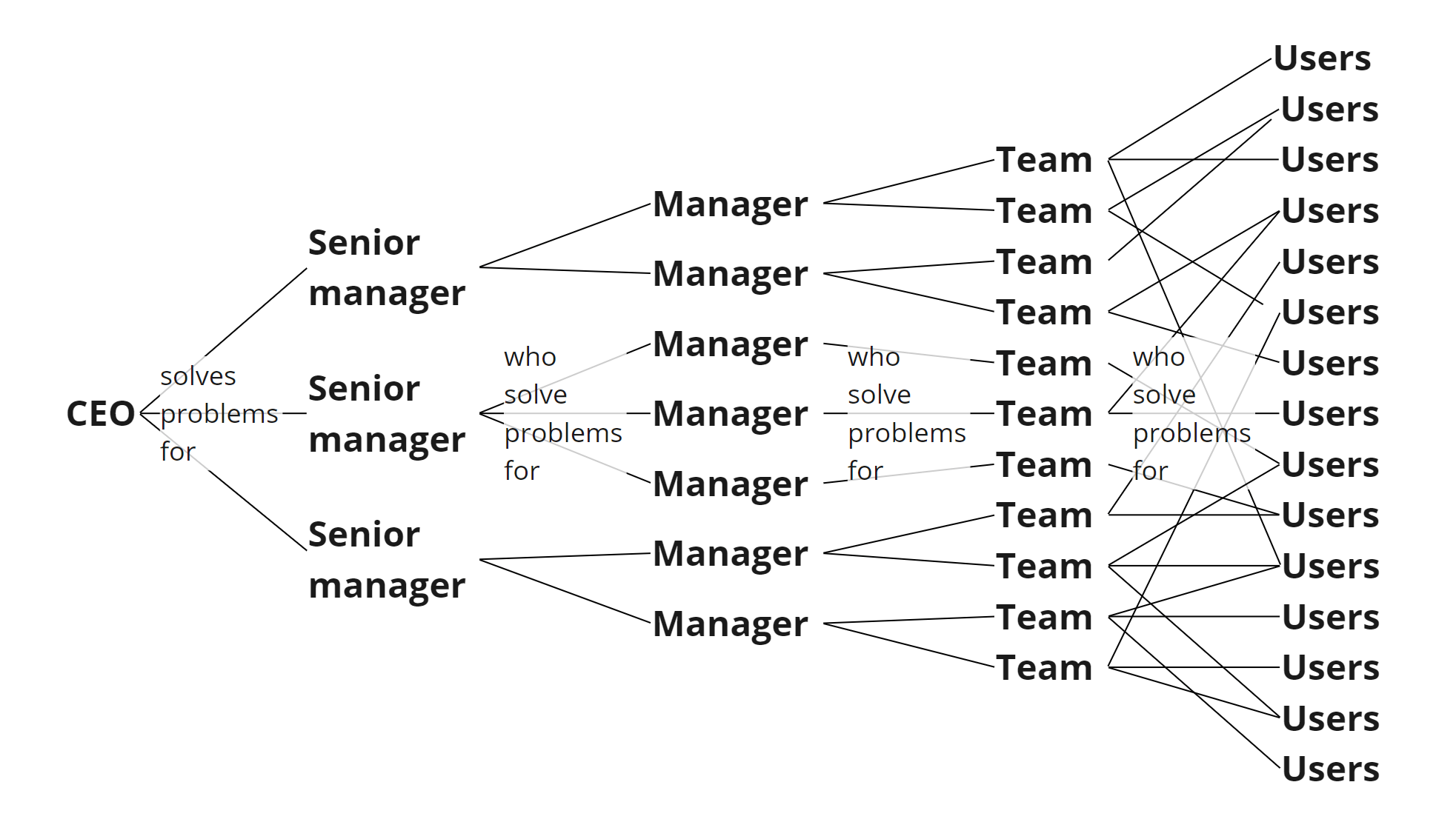
The challenge of digital transformation is to integrate the organisation into the society-wide digital ecosystem so that people continue to be as ‘digital’ at work as they are in the rest of their lives, not to bring ‘digital’ into the organisation and make people do work in digital ways.

Then, they stepped back over the boundary and went back into their digital lives of watching videos, shopping online, getting a taxi, do their banking, turning up the heating.

Brilliant blockchain ideas

Blockchains offer a means of creating an immutable record of transactions on a peer-to-peer network of computers. Here are some brilliant ideas of things we could use blockchain for:

  • Record the usage of toilet paper in public toilets – As each square of toilet paper is dispensed a transaction is added to the blockchain so that an everlasting and never changing record of how many squares of toilet paper were used in each visit is maintained.
  • A single pixel of a famous photo – If you’re NASA and you own the rights to iconic images such as the Blue Marble from the 1972 Apollo mission, why sell the image as a whole as a single NFT when you can sell each individual pixel and create a unique and finite community of Blue Marblers.
  • Every tin of beans – In fact every piece of food produced is recorded on a blockchain, with transactions added each time it changes location, from manufacturer to wholesaler to supermarket to your kitchen. Your smart kitchen communicates via bluetooth with every piece of food within it so when you open the tin (or your robot butler does) that too is added to the blockchain so that everyone knows beyond a doubt that that tin of beans has been consumed.
  • Blockchain of blockchains – Create a blockchain that records that every transaction that happens on every other blockchain so that there is an immutable record of all the blockchains. Just in case.
  • Santa’s list of naughty and nice children – Every child in the world is added to the blockchain , and every time each of them does something naughty or nice another block is added, enabling Santa (or more probably Elves with PhD’s in data science) to maintain an unarguable list of which children are getting presents this year. Santa could sell licenses to enable apps to be built that show the data for convincing children to behave or marketing toys to them.

If you’re looking for something more helpful, this demo of how a blockchain works is great.