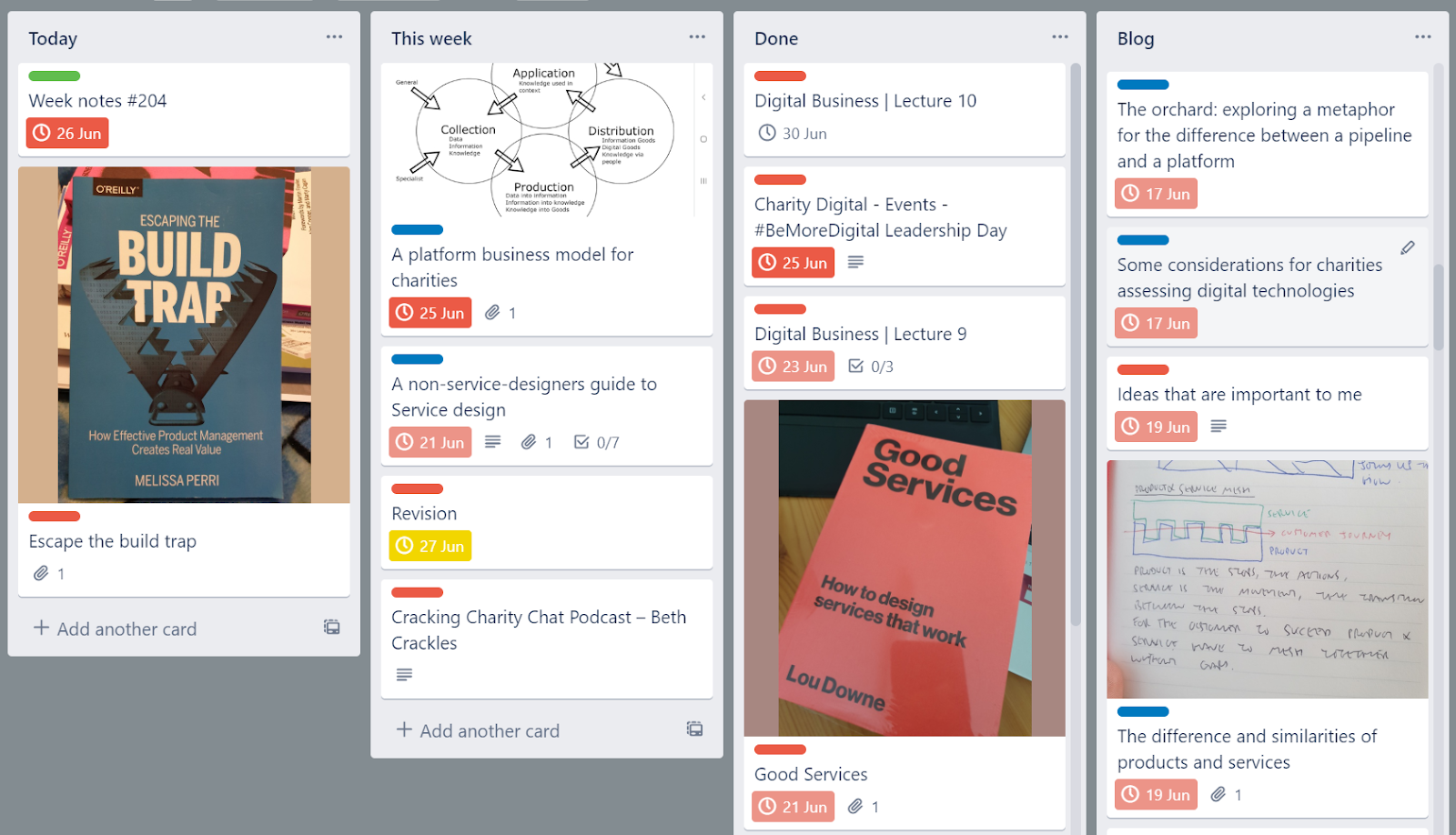
Weeknotes #214

I did:

The future is asynchronous

I presented some discovery work I’ve been doing for the next phase of our online learning environment. It has been centred around user needs of accessing the platform, booking on sessions, and asynchronous session delivery. Thinking about asynchronous delivery, all the different ways we can support young people to achieve outcomes, is really interesting. It opens up so many more opportunities not only anytime/anywhere, but more importantly about how young people develop a sense of agency around their professional development.

Some thoughts on the Charity Digital Code of Practice

What might a digital charity look like in fifty years? What kinds of thinking models might be needed between now and then to make digital every part of a charity? “Becoming a digital charity offers new modes of operating. It isn’t just digitising existing ways of working, but completely transforming the business model and how they achieve their purpose. But its all about steps in the right direction. The Charity Digital Code of Practice can help charities think about what those steps might look like.”

Launched The Fire Control Problem

I launched my SMS course after the team at Arist helped me with a technical issue of their system not accepting UK phone numbers. Its one of those virtual world meets the physical world problems.

Its interesting to me to be using the process that the course describes in figuring out what to do with the course.

Things I’ve learned so far:

  • SMS learning is for individuals. It seems obvious but I hadn’t really thought about it. There is no sense of other people learning the same stuff like you might get from a more open platform like Twitter.
  • SMS is very one way. It doesn’t allow users to question or debate the contents, they have to take it at face value.
  • The concept of achieving uncertain goals rather than the usual approach of defining them first is a bit of a hurdle to get over, and if the user doesn’t grasp the proposition from the start the rest of the lessons might be a bit confusing.
  • The concept might lend itself to an exploratory approach of ideas rather than purely as a means to achieve goals.

Year 2: The revenge

I picked the modules I’ll be studying for the second year of my MSc:

  • Innovation policy and management.
  • Digital creativity and new media management.
  • Blockchain technology and its impact on innovation, management and policy.
  • Research methods in management.
  • Dissertation.

It’s going to be a busy year.


I thought about:

Culture eats strategy for breakfast

Catchy statement, sounds like it might be true, but how might you test it? It seems to me that if you were to describe what makes ‘culture’ and ‘strategy’ opposite to each other you might describe culture as more subtle, amorphous, vague, driven by story-telling, and strategy as objective, defined, perhaps more scientific or numbers-based. So, based on this, if an organisation is driven by its narrative rather than by insights, then it could be true to say that it is led by its culture and not its strategy. Another question is whether that’s a good thing or not. (And just to add another thought; “Systems swallow culture and strategy whole”.)

Testing vs learning

When launching a product, testing is about confirming what you know, learning is about being open to finding out things you didn’t even know you didn’t know. Both are important but learning is the most difficult because it can only happen with real people using the product.

The fear of digital

What is the fear of digital about? Is it the fear of being replaced, the fear of the new, of the unknown?

Stigmergy

“Stigmergy is a form of self-organization. It produces complex, seemingly intelligent structures, without need for any planning, control, or even direct communication between the agents. As such it supports efficient collaboration between extremely simple agents, who lack any memory, intelligence or even individual awareness of each other.” Maybe this is the opposite of strategy that I’ve been looking for.


And I read:

Remote work and the future of the high street

The high street is dying. Remote/home working as a result of COVID 19 is exacerbating this. But I think there’s an opportunity to do everything better.

Ross describes a town where, “Air quality is high. The local economy is booming. Social mobility is high and unemployment is low”, and essentially asks the question is it possible to have all of these things in the same place at the same time.

So, if I understand what he’s saying correctly, rather than office buildings being full of people from a single company there will be offices with people from lots of different organisations. These co-working spaces will bring people into town centres via environmentally sustainable transport and thus making town centres being convenient places for the kinds of tasks that you have to do in person, things like getting a haircut, banking, and frequenting a cafe or coffee shop.

But we have to ask, why do those things require lots of people to all travel to a location that is convenient for the hairdressers, banks and cafe owners, rather than the business travelling to convenient locations for their customers? The answer used to be obvious, because its more economically viable for the business and because consumer behaviour supported it. When people had no choice but to go to workplaces then businesses would open to provide for the needs of all those people in one place. Giving people a choice changes consumer behaviour. If everyone has a choice (and of course not everyone will) about whether to go to a town centre to work, will there be enough people to sustain that local economy? There will undoubtedly be fewer people, so what defines economic sustainability might be different to pre-COVID times, but will is be enough to drive cause low unemployment and high social mobility?

I think the nature of the problem, as with so many of the post-COVID-rebuild efforts, is one of tight or loose-coupling. In pre-COVID times town centres, and lots of other parts of the economy/society were tightly-couple. Tight-coupling is fragile and risky, it relies on stability throughout the system, it can’t accept too much drastic change. Tightly-coupled systems are like a house of cards, if one card shakes, those connected to it and connected to those that are connected to it feel the effects of that shaking. To create another tightly-coupled system of town centres, one where each part is reliant on all the others for its stability and success, would be to fail to learn from the shock our economy is going through. So perhaps Ross’ vision of town centres as nice places to work could be a reality, but depending on how it is built effects how long it lasts.

An example of the loose-coupling of town centres? Amazon is buying town centre warehousing space far more cheaply than it could of when high street property values were at pre-pandemic levels so that they can deliver across the surrounding town far more quickly than they could from warehouses farther away. Amazon know how to be loosely-coupled. Their warehouses don’t have any great reliance on the surrounding infrastructure and systems that make up a town. As long as Amazon can get vans in and out of the warehouse and have a steady supplier of workers (and if not they’ll bus them in from other towns), they are happy. Whatever happens in the local economy, Amazon can continue unaffected. That is loose-coupling.

The Hacker Ethic of Work

“In the hacker ethic of work, work has to be interesting and fun and, above all, must create value for the worker, the organization and for society as a whole. Workers also must have freedom to organize their work in a way that is more functional to reach their own goals and in the manner that best fits their needs and insights”.

Simone Cicero, who has written more recently about platforms and complex systems, wrote about the hacker ethic of work in 2015, describing it as in the quote above, as an approach to work that involves creativity and freedom. In our complex world, an organisation that is able to adopt the hacker ways of making things that are open and reusable, collaborative and co-created, agile and flow-based, and understand user’s needs can become market leaders.

For me, this article from 2015 and Ross’ article are connected by a thread that approaches work more from the side of the worker than the side of the organisation. Both seem to me to be asking for a change. They recognise a move away from the industrial concept of the worker as a tool to be used by the machines of business and towards the worker as a nodes in the complex systems that make up our economy, society, and environment.

Simone says, “as individuals living today we have a duty to face the future with the eagerness not just to see it happen but, rather, to choose to be part of it and give it a different shape”.

Industrialisation

Industry and its discontents“, a podcast by Seth Godin in which he talks about the system of industrialisation. He says industry craves productivity because cheaper wins but cheaper products require cheaper labour, which requires of people that they do morally questionable things to meet their short-term needs. This feels like one of the most important podcasts I’ve ever listened to and mentions many of the justification for moving away from the industrial mindset.

I see in all three of these the theme of society moving away from industrialisation and towards digitisation. The digitisation of society won’t provide some perfect utopia, it will be full of challenges, problems, inequalities, and unintended side-effects

It’s about legacy

“A “programme in which they repair stuff” shouldn’t be compelling viewing. It’s only made so because we hear people’s stories, and what the objects mean to them. And within each episode, we have the “will they be able to restore it? What will it look like?” arc of the chosen objects. We need to be clear that fundraising works best when we talk about individual stories, and what changes as a result of a donor’s support and our organisation’s intervention. This is how we make a connection.”

I’m fascinated by fundraising, as a discipline, a sector and a practice. I think, because it seems so unique. It only exists in the third sector. Things like HR and Marketing, as interesting as they are also, exist in every sector. So, Richards newsletter, and his post about The Repair Shop are like little peaks into the world of fundraising and the mind of a fundraiser.

Because of the way my brain works, I struggle to understand the things Richard talks about, things like love, legacy, restoration, and I guess the connections that storytelling creates. I can conceive of fundraising in a transactional way as a value exchange between three parties; the donor, the charity, and the beneficiary, and how is differs in nature from a commercial value exchange between two parties and adds to fundraising’s uniqueness, but how it actually works in practice is a mystery to me. Is it just marketing by another name? Is it sales, or should it be? Perhaps what I’d like to understand is more about the approaches fundraising uses to fit it into my mental models for the shift from industrial to digital.

Oh, and he mentioned my tweet about what a strategy needs to express in his email newsletter, which was a complete but nice surprise.


Some people tweeted:

Salaries in charity job adverts

There is a claim (I see it mostly on Twitter, from which you can draw you’re own conclusion) that putting the salary in job adverts helps to tackle the gender pay gap. I was interested in where the idea comes from, how robust it is in theory, and whether there is any research or evidence, so with a bit googling I tried to track it down.

There is a press release from the Young Women’s Trust that states, “Employers should stop asking job applicants how much they earn and include salary details in adverts to help close the gender pay gap”. The press release goes on to mention the salary history/wage equity laws that have been introduced in the United States that make asking a candidate about their current/previous salary illegal but doesn’t mention salaries in job adverts again.

I couldn’t find any research that concludes that including salary details in a job advert has any affect on the gender pay gap (I’m not suggesting that it doesn’t exist, just that I didn’t spend very long looking for it). There is some research that says following salary history bans employees received “increased pay for job changers by about 5%, with larger increases for women (8%) and African-Americans (13%). Salary histories appear to account for much of the persistence of residual wage gaps“. And I there is some research that shows that “when there is no explicit statement that wages are negotiable, men are more likely to negotiate for a higher wage, whereas women are more likely to signal their willingness to work for a lower wage. However, when we explicitly mention the possibility that wages are negotiable, these differences disappear completely.

Looking it at from a complexity point of view of course its impossible to know what action will have which result so we can’t say that having salaries in job ads won’t contribute to tackling the gender pay gap, but based solely on what I’ve seen, we can’t say that it will either. Perhaps it is better instead to focus on a wider commit to better hiring practices across the the charity sector.

Also, I’ve seen concerns expressed about how we go about making change happen. If naming and shaming charities on Twitter (and actually, organisations don’t tweet, real people probably with the words ‘social’, ‘media’ and ‘executive’ in their job title do) is the default means to get them to change their practices, then what does that say about the charity sector?

But, here’s the interesting question: in a world of misinformation and easily swayed opinions, if something feels like the morally right thing to do but is based on growing public opinion and not on firmly established research and viable hypothesis, is it still the right thing to do?

Architecting organizations by designing constraints

Simone Cicero tweeted “A new approach to organizing is slowly establishing itself. This new approach is essentially small-scale, emergent and outside in, and doesn’t aim at simplifying complexity but at rhyming with it. This approach is based on architecting organizations by designing constraints.”

This is intriguing to me because of my interest in modes of organising within the three spheres of society. If Simone is seeing a new mode in the market sphere, one that conforms to more modern, perhaps non-newtonian, concepts from complexity science, then I’d like to understand more about it.

Is the market unsympathetic?

Justin Jackson tweeted “The market is unsympathetic to your passion. You can build whatever you want, but ultimately you’re beholden to the market and what it wants. Without customer demand, you don’t have a business.”

Yes, in the most obvious way, as we understand markets as unthinking mechanisms of capitalism, they have no sympathy for what any individual puts their time and energy into. But the reverse doesn’t seem to be true. Markets do need people who are passionate and invested in what they build and how they build it because without that passion nothings gets built and the market has nothing to be unsympathetic about.

Fake Grimlock replied: “LEARN PASSION FOR THINGS PEOPLE WANT. IT THAT SIMPLE.”

Weeknotes #213

This week I:

Creating guidance

I’ve spent quite a lot of time working through the logging-in process to figure out improvements on the technical side and in the guidance we provide. Guidance content is an interesting challenge in many ways. When the user is on a mobile device they have to switch between the guidance which might be on a web page open in a browser app and the app they are logging into, or between the guidance in an email and logging into a web page in a browser, either way there is lots of switching between the two which makes it difficult to keep track. The guidance also need to check that they are taking the correct step and not just assume that the previous step was completed correctly, otherwise the instructions become increasingly confusing.

Developing a digital mindset

I started a blog post that was meant to be a few quick reflections on the Charity Digital Code of Practice. I’m less than half way through and have already written more than two and a half thousand words. I seem incapable of writing short blog posts, but I’ve definitely found it really interesting how so much of digital thinking in the charity sector is short-term implementation. I struggle to find anyone thinking about the vision of digital charities or the mindsets that will be required of digital charity people in the future. There seems to be the general expectation that we’ll be able to continue to use the same old ways of thinking and just apply them to digital. Anyway, I hope to finish the blog post over the next few days.

Finished hiking the Ridgeway

Last weekend I hiked the final twenty five miles of the Ridgeway. It has taken my brothers and I three years to complete the almost ninety mile route. I don’t spend very much time with my brothers, and this hike reminded me why. I’m quite different to them. They talk about what they’ve watched on Netflix and the houses they are buying. I talk about the ethics workshops I went to last week, my plan to spend the next few years on a roadtrip around the coast of England, Wales and Scotland.

How to hit a moving target

I turned some of my thoughts about achieving uncertain goals into a short course delivered via SMS. It is in part to test whether short courses using delivery methods such as SMS, Chatbots and scheduled emails should be part of our proposition at work. How much value can you really get out of a few text messages? I set up a landing page, and just need to finish writing the course and then get some people to sign-up.

Charity Island Discs

I watched Wayne and Lesley’s video for Charity Island Disc. I think stuff like this is wonderful community-building activities. It makes me think about my mountainboarding days where we tried to do lots of things to bring people into a community. Fundraising, as a function/career-choice/whatever is really fascinating to me. I don’t know very much about the practice of fundraising or the sector, but it seems unique to the charity sector (whereas most of the other function, e.g. HR, Finance, Marketing exist in corporate sectors) both in what it does and how it works. It would make an interesting social graph and might reveal whether there are people in the community who are pivotal to that community. My expectation would be that there aren’t, and that the community isn’t structured that way (like the mountainboarding community was). Given the income distribution of charities in the UK (95% with income lower than £1m) I wonder if the social graph of Fundraisers would correlate with the vast majority of Fundraisers not being part of or even aware of the community, but those involved in the community being more closely connected with the larger charities.


And I thought about:

Mind blowing ideas

In thinking and researching for the blog post I mentioned above I’ve learned a little bit about paternalism in charities, complex systems leadership models where authority is an emergent property rather than being held by a single gatekeeper, the history of usability and user research, especially in helping people use software, how maybe the idea of user-led organisations comes from the social model of disability, and how strong organisational culture used to be considered a good thing but now maybe utilising the strength of weak ties might be better.

All the unfinished projects

I have so many unfinished projects. Some of the ideas were complete rubbish, some were probably ok but I got bored and moved on. I bet so many people are the same. What if there was somewhere where we could all upload the projects, whatever stage they are at, from idea to validated audience or whatever, and then other people to take on the project, progress it a bit, mix projects together, reinspire each other. Of course, I can’t start this because I’ll never finish it.

Tecthics

I still have to write up my thoughts around all the research I did last week around tech ethics, ethics frameworks, a guide for charities introducing decision-making technologies, and probably a bit of a rant about people talking about tech ethics when really they just mean applying their ethics to tech.

Jobs To Be Drunk

I started reading When Coffee and Kale Compete which takes about the Jobs To Be Done framework for understanding that customers ‘hire’ products to accomplish things for them (people don’t buy drill bits they buy holes).

My website visitors

My little website gets about 20 visitors a day, and almost none of them read the stuff I write about, which I’m completely fine with. The steady stream of traffic seems to be from weird occurrences of search results like how my website shows on the first page of google along with Simon Sinek’s website and twitter account for the phrase “what almost every leader gets wrong”.

Screenshot of first page of google search results

I posted Sinek’s video to the Notes section of my website so I’ll be able to find it next time I want it. I wonder if I should add my thoughts about what he says to the page? Nah, I’ve got plenty of other half-finished blog posts that I’m far more interested in.


And some people tweeted about:

Building app when you’re not technical

Janine Sickmeyer tweeted “Non-technical founders always ask how they can build an app if they don’t have a tech team” She goes out to give some really good advice about identifying a problem and customer pain points, prioritising features for an MVP before going into the options of hiring a tech tean, using no-code tools, or a hybrid approach.

The Ultimate Guide to Writing Well

Dalton Mabery wrote a thread of advice about writing online from David Perell. The advice includes “There are no original thoughts, only original combinations”, “People will follow those who have earned trust, credibility, and authority. Those can’t be bought, only earned over time.”, and “Consistency develops ability”. These threads about writing online whilst writing online get a bit meta but I find the ideas about writing online (in this thread and in general) really interesting as uncovers some of our ideas about how expert knowledge and information sharing is and isn’t supposed to work.

What email service do you use for newsletters?

I bookmarked this thread as soon as I saw it as I knew it would create a really useful up to date list of all the new email newsletter providers which I’m sure I’ll need soon.

Alfie goes paddleboarding

https://twitter.com/RNLI/status/1299369907491082240

Weeknotes #212

This week I did:

Affecting the most important measure

We’ve been doing some user research guided by a kind-of North star of ‘effective skill learning’ to understand how much of effective skill learning is contributed to by the contents of the course, the method of delivery, and the relationship with the instructor. My sense at this stage is that the relationship accounts for about 60% of the outcome, the course content about 30%, and the technology only about 10%. If I’m right this will help us ensure we make decisions that maximise the relationship element and reduce anything that damages that.

Retros & reviews

I had some interesting discussions about how piloting new technologies and operating procedures should be used to uncover issues and weak points before rolling out to a larger audience, and not have the expectation that pilots are going to run perfectly. Things going wrong in a pilot makes the pilot a success because then you can fix them so they don’t happen in real scenarios.

Blended learning

I’ve thinking about what we build next and how our concept of ‘blended learning’ works. I’m not sure that defining the ‘blend’ by channel. i.e. digital and physical is helpful in creating the learning experience. I prefer to think of us as providing a blend of synchronous and asynchronous delivery, so that young people can access a programme that is presented live (be that in person or via video) and they are access it at times suited to them (be that by watching video in the evening or working through tasks at the weekend). How this looks will come out of our understanding of what aspect (as above, content, delivery method or relationship) matters most in effective learning. So, if the relationship has the biggest impact on effective learning then we can prioritise the part of the blend that enable relationships, but if delivery method matters most then we’ll focus our efforts on improving that. We can then decide how the blend of synchronous and asynchronous apply on different levels, so should each step in the journey and module have a way of being taken synchronously and asynchronously, or are some parts only available as one or the other but overall the programme is synchronous and asynchronous?

The ethics of moderation

I’ve been writing a discussion paper on the ethics of decision-making technologies in charities. I hope to finish it this weekend and share it with our Safeguarding Board and other stakeholders to start the discussions about ethics next week. It’s a really hard thing to write but I feel like I have a responsibility to push for the ethical use of data, technology and products.

Work in progress

I started using Notion more and got my workspace set up. I add to my library, tidied my tasks list and roadmap (which used to be in Trello), and wrote this blog post in Notion (I used to use Google Docs). I’m hoping it will improve my workflow, help me collect ideas and references more effectively as i’ll have everything in one place.

I looked at using Airtable but it didn’t have any easy way to create records from sharing on my phone, and as I do quite a lot of writing, didn’t seem like the right solution.

I have my ideas database where I record ideas and concepts that I get interested in so that I can find the info I’ve previously researched easily. I’m still using the notes section of my website for more public sharing of things I find on the internet so I need to decide whether moving them to Notion will make it easier to access previous research or just over-complicate it. I also need to get better at noting my own thoughts and ideas.

Introduction to tech ethics

I went to an online workshop with philosopher Alice Thwaite on tech ethics. We talked about freedom and how it’s more important than freedom of speech, how technology amplifies speech, Foucault and how anonymity creates power, how design is a process of changing from the current state to a desired state, normative and descriptive statements, the UN declaration of Human Rights, deontological and consequentialist ethics for handling information and making decisions, creating an ethical framework and how ethical considerations should be criteria of success for the products we build. Quite a lot for two hours.

Ethics of AI & algorithms

And I went to another of Alice’s workshops on the ethics of artificial intelligence and algorithms and talked about how power is a better way to talk about AI rather than bias because it elevates the discussion from about the tech to its affects on society, theories of power and ways power can be held over others legitimately or not, and creating a target goal, model, training data and algorithm for an AI system.

Product Management and the public interest

Kathy Pham from Harvard Kennedy School convened 300 product mangers to meet online to listen to lots of three minute lightning talks on the topics of “how product is different in mission focused organizations and companies, and what public interest tech means at this point in time”. With people from the UK, US, Canada and Philippines working in all kinds of different public interest spaces from government to parenting and housing to advice. Three minutes isn’t very long (I guess unless you’re the one doing the talking) but it gave a really wide range of the different problems products people are tackling. It made me wonder, if I was going to do a talk, what would it be about?


Thought about this week:

Tech ethics, tech ethics, tech ethics

Most of my thinking this week has been about tech ethics. From two workshops with the philosopher Alice Thwaite, reading Future Ethics by Cennydd Bowles, listening to podcasts Kate O’Neill, and Rachel Coldicutt sharing some of her thoughts in answer to my long list of questions about tech ethics in the charity sector, I feel like I have lots of different perspectives that I need to figure out and fit together.

Tech ethics is a really interesting topic to learn about, and something I want to include my essay about AI, and use as the basis for a blog post about guidance for charities introducing decision-making technologies, and write a discussion paper for work, so I need to take the time to make sure I’m taking in all the stuff I’ve learned.

Posthumanism & Actor-Network Theory

Posthumanism offers an idea to redefine humans beyond the humanist ideas that were defined in the middle ages by white men (and probably contributed to lots of discrimination throughout history) and into the future of our species as we become more connected with technology.

Actor-network theory uses the principle of generalized symmetry to say that all of the elements of a network have equal agency, including the human and non-human actors such as the systems that form a network. To me this starts to form a different approach to ethics for the future.

These both seem to be quite future-looking theories with some focus on the interaction between humans and technology so they are also interesting to think about and frame some of the thinking I have for my essay about the effects AI will have on our society.

Building an accessibility business

Jonathan sent me some documents on his thoughts about strategy for A11y.space. I really enjoyed reading them and thinking about business strategy. It’s one of those complicated real world things where no matter what model you apply nothing ever fits. It’s been a while since I had to think that way and its so easy to get tied up in knots that lead to inaction. Anyway, the internet needs to become more accessible and I’m sure A11y.space can contribute to it.


Tweets from this week:

How did Uber grow so quickly?

Scott Gorlick tweeted about how Uber approached growing. One of the fascinating things is how offline all the methods they used are. It shows how the myth around internet businesses and being purely digital are so wrong.

Digital job competencies

Dan Barker tweeted “Here’s a list of competencies that people use in ‘digital’ jobs. Which of these would you say are most important for your job/area? What is missing from the list / what doesn’t fit?”

With things like ‘analytical thinking’, ‘influencing others’, and ‘objective analysis’, the list is interesting for not mentioning words like ‘digital’, ‘data’, ‘design’. Instead it focuses on the core competencies of modern work that enable people to solve complex problems in fast changing environments rather than the traditional factory-like concept of work where workers are expected to do what the manager told them (a simplistic contrast, I know, but there does seem to be qualitative differences between the modern workplace and management approach and its older version).

Let the people learn

Hermanni Hyytiälä tweeted “If organisations want to get better at what they do, then their people have to be able to learn. Working within a rigid operating model that is designed on outdated management assumptions and related structures makes it almost impossible for employees to reflect and learn.”

Like I’ve said before, you have two jobs: learn and integrate that learning into the organisation. Employee knowledge is an intellectual asset that organisations should utilise as a competitive advantage.

Weeknotes #211

This week I did:

You can’t learn without launching 

The pilot of our Online Learning Hub went live this week. I love pilot go lives. I love how everyone seems to think it means job done and to me it means we can finally start learning. And I learned loads. I made sure I was part of first line support helping young people and volunteers solve any technical or usability issues that came up. 

User research can tell you what problems people are facing but the only way you can learn whether your product can solve their problem is to get them using it. Maybe this is the hill I’ll die on.

How rad is Wayne?

Wayne asked for recommendations for website builders, with the replies including what people use for their sites. I realised I’d never done a comparison of Wix, Squarespace, WordPress.com so I quickly created three websites to let people know just how rad Wayne is. I found Wix the easiest to learn and quickest to create a site with. SquareSpace wouldn’t let me publish without paying them. WordPress was probably the hardest to use (even though it was most familiar to me) (and Jonathan did Webflow). I did think about writing up the comparison so it could be a useful tool for whenever anyone else asks the question Wayne asked, but Irealised that I’ve never be able to keep it up to date as all those platforms are constantly changing.

Tech ethics 

I became very interested in charity tech ethics and quickly blew my mind with all the stuff I read, podcasts I listened to and chats I had with quite a few people on Twitter (more than I ever have, including Hera Hussain and Rachel Caldicot, who are kind of heroes of mine).

I started a doc with some questions about charity tech ethics which I’m hoping some of the people I spoke to on Twitter will contribute to (although I’m sure they weren’t expecting four pages of my rambling thoughts when they offered to help).

Something I noticed about how some people talk about tech ethics is that they really just mean that they don’t like the ethics of a big tech company like Amazon or Facebook. I don’t get the impression many people have got any further into tech ethics than the obvious dilemma of charities using big tech to work with people knowing that those companies are using those people’s data in ways the charity might not agree with, but the charities feeling like they have no choice as that’s the tech all of their beneficiaries use. I find the ethics around charities using decision-making technology, and tech ethics in general, fascinating so I’m keen to spend some time understanding it better and maybe write a blog post with some guidance for charities thinking about implementing decision-making technologies.

Digital business exam

I scored 80 on my exam (my highest score), which takes my average to 67.


And thought about some stuff:

Solutionising or outcomes

When doing discovery work, writing use cases and requirements I often hear the phrase, “Don’t solutionise at this stage”, which I agree with, but sometimes wonder if we get confused between what looks like a solution and what is actually an outcome we’re trying to achieve. I’ll look out for more examples and think about some more.

Newsletters

I’ve been thinking about improvements for email newsletters. Email is a great delivery mechanism, and if you’re using a newsletter app then consumption is pretty good. Where there is space for improvement is in collating and curating content. Currently each email newsletter is the work on a single athor. If there was a platform where authors could upload articles and subscribers could subscribe to topics, then the platform could send the subscribers email newsletters with articles from a range of authors but about the same topic. 

Phygital

hancock.lighting is an interesting concept, taking a physical world thing and making a digital version. I wonder what else in the real world could have a digital equivalent and how you’d make the connection between the two.


And read some tweets:

Writing about writing

A small collection of tweets about writing:

Superpowers

Shane Parrish tweeted: Superpowers you can have:

  • Ability to change yourself & your mind
  • Not taking things personally
  • Not needing to prove you’re right
  • Careful selection of all relationships
  • Staying calm
  • Being alone without being lonely
  • Being ok being uncomfortable
  • Thinking for oneself

And Dickie added:

  • Laser focus on one task at a time
  • Easily spotting bottlenecks and leverage points
  • Creating tight feedback loops

I find the kinds of things on lists like these interesting because they have no clear means of learning. They are wisdoms; knowledge + judgement, only gained through experience.

Expressing a strategy 

I tweeted: A strategy needs to express:

1. Where we are now and why we can’t stay here.

2. Where we want to get to and why it’s the right place for us to go.

3. How we’re going to get there and why this is the right way for us to do that.

I’ve since been thinking about a fourth question, something like “How will we know we’re heading in the right direction and what would cause us to change?”

I think it was probably my most successful tweet ever, not because of its contents but because James Gadsby Peet replied, which got it noticed by his followers, and so on as things do on social media.

Weeknotes #209

This week I did:

Operational readiness 

We spent a couple of days doing operational readiness testing ahead of going live next week with our ‘Online Learning Hub’ (don’t get me started about naming virtual properties like it’s the year 2000). We had four test teams and learned a lot about the experience young people will have when they are on our programmes. It also helped me think more about how we can focus more on mobile without some of the constraints we’re finding at the moment.

Next phase

We are about to start the discovery phase for the next level of learning experience we provide young people. I’ve been thinking about how closely tied the technology is to the mode of delivery, and that I’d like to explore within three concentric circles; what more can we do with the tech we’re already using, what can we do with tech we already have but aren’t using to support different modes of delivery, and what tech would we need to support modes of delivery that we aren’t doing. Layered under that is the notion that different young people have different needs so we need to provide different means for them to achieve their outcomes.

Stile-ish

I’ve been adding more stiles to stiles.style, and I got a couple more followers. But the best thing has been the chats I’ve had with people whilst taking photos. They usually start off suspicious, thinking I’m doing something wrong, but when I tell them about my instagram account they relax and we talk about how stiles are an important feature of the British countryside, how each one is unique and that they are gradually being replaced by gates.


Thought about:

Weaponisation of digital

I’ve been gradually starting to put more time into my essay about how digital technologies will be weaponised to increase inequality in society and what charities need to do about it. I think of essays as very different pieces of work to blog posts. They are longer and include research and presenting other people’s opinions, whereas blog posts are just what I think. I’ve settled on a timeframe for looking at this future. It’s within the lifetime of someone born today, so roughly a hundred years. And it follows a three-part structure of what the technology will be like, what inequalities we can expect and what charities need to do to get ready for this future. There is a section about AI, so I’ve been reading about Turing, Kurzweil and Bostrom. They all recognise how seismic the creation of AI will be for our species and how inevitable it is.

Agile education 

I found AgileInEducation. They talk about how the “world is no longer predictable and learning needs to be more adaptive, connected, and interdependent” and about shifting education from Prescriptive to Iterative, Content to Culture, Evaluation to Visible Feedback & Reflection, Control to Trust and Competition to Collaboration. The website doesn’t have any more information about how this might be done, what situations and contexts it applies, etc., but it sounds interesting.

Is agility in education solving the same problem as agility in software development? Do we use the same words but mean different things? Does the shift in ways of thinking and doing education need the Agile brand or is it just ‘education’ evolving with the times.

I also read a paper called ‘Agile Methodologies in Education: A Review: Bringing Methodologies from Industry to the Classroom’, which is more explicit about the problems teachers are trying to solve by using agile ways of working, that is to ‘attract and retain the attention and the commitment by students, and ensure they achieve the required learning outcomes.’

How I spend my time

I’ve been thinking about how I spend my time and whether to break it up more so that I have blocks of time for writing, studying, walking (Stile-ing), etc. Is it better to spend more time on one big thing (like my weaponisation of digital essay) to get that done before moving on to other things, or is it better to have more things in progressing a little bit at the same time. Kanban thinking might say that I need to define my Work In Progress limits. I also did some roadmapping to help me check that what I want to work on is going to help me achieve my objectives.


People tweeted:

Platform for collaborative working

Adam Groves tweeted about some thinking he’s been doing around the dynamics that underpin effective collaboration in organisations. It shows some really interesting platform thinking for collaborative working.

Creative explorative learning space

Shreyas Doshi tweeted 

“Five concepts with incredibly high ROI: 

  1. Talent Stacking, 
  2. High Agency, 
  3. Clear Thinking, 
  4. Deep Work, 
  5. Transactional Analysis”. 

I like this framing. It isn’t “Here are THE five keys to success”, it’s “Here are some interesting ideas to dig into”, which I think helps with learning and thinking as it creates a more explorative space.

Internet-businesses

Jordan O’Connor tweeted 

“Obsessed with this idea: 

  1. Pick a niche I’m interested in. 
  2. Write/study daily about the topic. 
  3. Write 100 articles in a year. 
  4. Get SEO traffic. 
  5. Build email list.
  6. Ask them what they want and build it. 
  7. Sell products (physical or digital).
  8.  Start fresh with a new niche next year.” 

The thread of tweets goes deeper into parts of the plan such as using Reddit to identify niches, and why picking a new niche every year is important because it keeps up with trends and grows the passive income over time. It shows how the idea of an internet-business is different from a business on the internet.

Individuals and interactions over processes and tools

Jason Yip tweeted

“I spent last week assessing every interaction I was a part of and identified 8 reflections:

  1. Advance preparation makes most interactions better;
  2. Some kind of supporting artifact to capture discussions makes most interactions better;
  3. Keeping track of time allows interactions to end better;
  4. Structured problem solving makes problem-solving interactions better;
  5. Clearer concepts and patterns for effectiveness helps progress improvement interactions faster;
  6. It’s easy to lose sight of the purpose of recurring meetings over time;
  7. It’s easy to miss that only a few people spoke in a meeting;
  8. Mumbling makes interactions worse”

I think this is excellent learning. It takes the high level manifesto item of ‘Individuals and interactions over processes and tools’ and breaks it down into actionable experiments anyone can try to learn from what Jason learned.

Weeknotes #208

This week I did;

The internet is open 24/7

Every website on the internet is available twenty four hours a day, seven days a week. One of the measures of success for a website is its up time. But what do you do when you want your website to have opening hours and not be available at certain times. It’s not an easy thing to achieve, especially with limited time and no budget. But we did it. Our tech guys came up with a single sign-on solution that only authenticates users between certain hours using API calls and cron jobs. I was impressed. Being able to control access at certains is part of our journey in understanding how to ensure the safety, security and privacy of young people in online environments. I guess most people think we’re just building another bit of tech to solve a particular problem but I spend a lot of time thinking about how it all fits together and what we can learn to achieve our vision.

Charity Service Model Canvas

I started experimenting with ideas for a Charity Service Model Canvas. Canvases are useful tools for seeing the big chunks of things all in one place, and done well they help ensure that balance decisions about whatever is being designed are made. So, for the Charity Service Model Canvas, the Needs connect to the Outcomes (are the outcomes of the service going to meet the needs), the Activities connect to the Resources (what resources are you going to need to provide those activities), in fact all of the boxes connect to each other. I thought about creating a Miro template for it so that people could use it when designing a service. Why haven’t I? Because I don’t know how.

The role of charities in the Democratic Society system

I wrote about some of my ideas about how the three domains of a democratic society system interplay and how the charity sector can choose to fit in to have an impact on society. I see our democratic society system as being made up of the three domains of state, market and civic, and look from a systems-thinking point-of-view at how they have mechanisms that are constantly interplaying with each other as checks and balances in the system. Each domain has particular organising modes which are used to empower and disempower members of society, and charities are one particular type in the civic domain that is useful where people want to organise around a particular issue or cause but need a means of centralising certain processes. 

How the cause-agnostic charities of the future will be innovators for the state and the vanguards of social change for good

I also wrote about an idea of a vision of charities in the future where they play a very different role in society to now. Rather than being focused around a particular issue or cause charities in this future would act as innovators-for-the-state and utilise their civic domain skills of organising people, fundraising, understanding social problems and developing solutions to solve social problems before handing over those validated solutions to the state to run, driving forward social improvements over time. 

Digital Trustees

I joined the Tech For Good Live event about Digital Trustees. I couldn’t stay for all of it but what I did hear was really interesting. I particularly liked the description of a digital trustee as someone who thinks in user-centred, data-driven ways, rather than being knowledgeable about technology. It’s almost like ‘digital’ is shorthand for modern ways of thinking, which I absolutely think it should be (that’s why I don’t always agree with the ‘don’t use the D word’ school of thought).

Got style

I started stiles.style. It’s either an ode to the nostalgia of the British countryside, a critique of the inaccessibility of the British countryside for less able people, or just something to amuse me on my walks. I can’t quite decide.


Some stuff I thought about this week:

Power in the civic domain

I think it’s right to challenge the established way of doing things. But the more established something is the harder it is to challenge without falling into the same traps as the thing you’re challenging.

In the civic domain power should flow to the people. That’s a value some hold dear, and an assumption that is hard to validate. Why should power flow to the people? Which people, all people, even those that disagree that power should flow to the people and have advantage over those suffering inequalities? Do we assume that if the people have the power society will be more equal? If so, what makes us assume that, is it based on any evidence or is it an ideal? 

The criticism that charities hoard power when they should be distributing it to the people is another opinion held by some. And the obvious conclusion that follows is that to solve this kind of problem the opposite situation should be created.

Charities are the way they are as a byproduct of the system they are in. They have whatever power others perceive them to have (because of course power is in the hands of the beholder and/or non-beholder) because of the structures of civic society. It’s not as if lots of charity CEOs got together one morning and said “let’s take the power from the people”. Charities are the way they are because that’s how the funding system works, and that’s how government regulations work, and that’s how the economy works. We can’t change charity and expect it to still work in those systems.

If we want to change how power flows in the civic space then telling communities that they should have the power because we jumped to the solution without really understanding the problem, just replicates the same power imbalance. It’s Pirsig’s rationality factory. So how deep do you go to understand power structures, and then how on earth do you approach building something different?

Products and services

What’s the difference between a product and a service? A product exists whether you use it or not. A service only exists when you are using it. A washing machine is a product, it still exists whether you are washing your clothes or not. AA breakdown cover is a service, when you aren’t using it it’s just a lot of men driving around in yellow vans. Let’s see how long that distinction lasts in my long running (actually, not that long) saga of trying to figure out the difference between products and services.


And some people tweeted this week:

Creating social change

Natasha Adams tweeted about creating a radical vision for the social change sector that is actually accountable to the communities it claims to serve. This is the tweet that started me thinking about some of the things above about power. When I see things like this I always have two thoughts; that action towards solution without understanding the problem can cause more problems than solutions, and aren’t we lucky that there are people in the world who are ‘do-something-now-ers’ to contrast those of us who are ‘think-about-it-and-probably-never-do-anything-ers’.

Acceleration

Lesley Pinder tweeted about charities who have set up accelerators outside of their normal structures. This is really interesting to me (I’m thinking it might be the topic of my dissertation) because more and more I think the best way to build new organisations (which is what most organisations really need when they talk about digital transformation) is to create a small splinter organisation that works to solve the same problems as the old organisation but in new ways and then transition people so that the new organisation grows as the old one shrinks and is replaced.

Charity sector facing financial catastrophe

Emily Burt tweeted about the financial catastrophe facing the charity sector. Seeing what was going on for charities at the time in a thread like that makes for shocking reading, but often, even seeing the writing on the wall doesn’t instigate action, especially if you’re not used to reacting quickly. Yes, the current financial situation almost every charity faces is going to result in a massive shock to the sector and society, but if charities don’t get better at acting faster, or can’t because of the system they are in, then that is a much greater and more far reaching catastrophe.

Strategy for change

Jason Yip tweeted “Strategy is non-iterative only if you assume a static environment and/or non-thinking adversaries”. Yes.

Weeknotes #207

Some things I did this week:

Platform thinking for safeguarding 

I wrote a discussion paper on how to approach achieving a high degree of safeguarding on a digital platform. As a platform (rather than a pipeline) it requires some different thinking (and maths) so, if two people have one connection, then 825 people 339,900 possible connections at any one moment (n * n-1 / 2 just so you know). When planning how to approach monitoring and moderating the platform it’s important to think about the right thing (the number of connections, not the number of people).

Variety pack

I had some user research discussions about how teachers might work with our educational content in a variety of circumstances, from selecting a re-arranged package that they use repeatedly to being able to build up a number of custom packages. Achieving the right amount of variety without providing an overwhelming number of choices (there are thousands of variations) is an interesting problem.

Becoming a cyborg

I watched Maggie Appleton’s talk about “How to Become a Neo-Cartesian Cyborg” and thoughts about the ‘Building a second brain’. It helped me clarify some of my thinking about what an idea ‘is’. I think it is a distinct piece of information; codified knowledge expressed in a transmittable way. Ideas, in this framing rather than ideas as aha moments, are the building blocks of creating other things. 


And some things I learned:

Simplifying the complex

When communicating, and by that I mean providing information with the purpose of convincing someone of something (communication isn’t neutral), simplifying that communication makes it more likely they’ll agree with you. Now, we could call that simplification ‘withholding all the facts’, but it’s a question of degrees. Knowing the boundaries of acceptable presentation gets the job done and keeps you out of trouble.

Fewest moving parts

Efficiency in machines comes from having the fewest moving parts. Where one moving part touches another moving part there is always friction and so energy lost through heat. A perfectly friction-free system would achieve maximum efficiency. So, when we talk about efficiency in working processes or reducing friction in a website sign-up process, we should look at the number of moving parts in the system first rather than thinking we can achieve those things with some surface-level changes.

Learning about learning

We we’re talking about behaviour change and pedagogical models at work, which are fascinating in their own right, but even more so when applying the thinking to creating a blended online education offer that allows people to self-serve some of their learning, receive specialised support, etc., and using those models to think coherently about how the subject is taught, what from the subject is taught, and how is the learning measured.

6G is coming

I didn’t even know 6G existed but apparently we’re expecting it to be rolled out in 2028. In fact doesn’t exist yet and is still in the research phases but the experts are predicting that it will provide internet connection speeds of 1 terabyte per second (the equivalent of 142 hours of movies in one second). 6G will also have a decentralised approach meaning devices can connect to each other without going through a central provider, which opens up lots of possibilities in real time sensor processing for augmented humans and artificial intelligence.


Some things I thought about:

All the problems

I look around and see so many problems, problems facing people right now, and I sometimes feel bad that I’m not doing enough to help solve those problems. I was thinking about this on one of my late night walks and it occurred to me that if everyone was working on solving the problems of today then no one would be imagining and investigating the solutions of the future. The work I do, and want to do more of, is around contributing to an understanding of what the solutions of the future might look like. The things I think and write about like cause-agnostic charities, the digital charity, platform business models for charities, and what the charity of the future might look like, is worthwhile work to be doing. It doesn’t contribute to solving the problems we face today, but I hope it contributes to solving the problems we’ll face in the future. 

Changing charity boards 

NonprofitAF wrote an article about boards of trustees being “archaic and toxic”. Apart from being a really interesting topic, one of the things I like about the article is that it presents a balanced view of the problem; that not all boards are bad, and that there are some ways in which organisations are trying out new governance models. I like this. I’m not keen on the spate of articles that seem to be written to attack particular aspects of the charity sector without offering any solutions to the problems they raise. I think reasoned critique that generates discussion and thinking is helpful, whereas ranting about a problem isn’t.  

Anyway, models of governance is something I want to explore with future.charity but my initial thoughts are that there needs to be some clarifying as to what charities need, governance, stewardship, or something else, not assuming that one type of governance fits all types of charities, and designing governance into the business model of the charity rather than as external to it.

Process models for knowledge management

I was looking at process models and how they have certain characteristics in common. So, for example: 

  • Design sprint: map, sketch, decide, prototype, test. 
  • Design thinking: empathise, define, ideate, prototype, test.
  • Double Diamond: discover, define, develop, deliver. 

They all have two characteristics in common; they are linear, and they are conceptual islands. The linear nature of them makes sense if a) you view the world and the work you do as non-complex, production-oriented work that can follow a simple step-by-step process, or b) you want to sell your model and you need to make it easily digestible by people who don’t have time to learn in-depth about how lots of process models should be used. These models are also always fixed (you can’t add another step, for example), unable to respond to change, and isolated, so not connected to other models. The more we recognise work as creative knowledge work that cannot follow the fixed process steps that these models suggest, the less useful these tools and models become. In fact, I think they become contraining of good work.

We need smart networked process models. Models that are capable of sensing and responding to change, that are interoperable, connected and able to communicate with other models, and are continuously improving. These models, built on the principles of the internet-era, need to reflect and utilise the complexity of the world and knowledge work, and be part of an ecosystem of models that support good knowledge work.

And perhaps organisations need Knowledge Managers whose job is about teaching people how to use tools and models effectively. Just as organisations have project managers who are responsible for the ‘when’, the flow of the work, knowledge managers would be responsible for ‘how’, the ways the work is done. They would be part of the shift organisations need to take away from the industrial production-oriented mindset of work and towards the modern creation-oriented knowledge work. 

I’ve seen organisations use the term ‘knowledge manager’ before when they mean ‘information manager’, and usually put that person in the IT department. Instead, I wonder if knowledge management, or to put it another way, intellectual asset management, sits better with HR/Learning and Development as it implies a different approach, that helping people know how to use the right conceptual tools is an important part of their work.


Some tweets I liked:

#CharityDigiReport

Zoe Amar tweeted about the Charity Digital Skills Report. Apart from the slight irony of the report being a pdf and accessed from a non-responsive website, the report has some really interesting but not surprising information about the state of digital in the charity sector. It says that “80% [of charities] are fair to poor at developing digital products”. That’s definitely a challenge with lots of causes, including the assumption that charity services should be delivered by people because this is essential to qualities of the service. I also found and started listening to the Starting At The Top podcast by Zoe and Paul Thomas.

Streaming apps

Paul Downey tweeted: “If you want a vision of the future, imagine a PDF downloading on a mobile phone — forever.” I’m not sure what he meant but lots of people seemed to take it as a bad thing. ‘Dystopian nightmare’ was mentioned. I’m not sure that it is a negative vision of the future for mobile. It’s a bit too centralised for my liking, but it’s conceivable that the mobile phones of the future don’t download an app and then connect to a web service in order to make the app do stuff and instead effectively stream apps and services to the phone in the same way we watch movies.

Who to follow?

Sonja Blignaut tweeted a quote saying “We follow those that reflect our most cherished ideals, not those who reflect the most accurate picture of reality.” Does the inverse work? Can we know our most cherished ideals by looking at those we follow? Or is it more complex than that?

Those who do not blog

Stephen Gill tweeted: “Those who do not blog about their mistakes doom other people in the organisation to repeat them” Well, yes. Not much more to be said about that, is there.

Weeknotes #206

This week I did:

Writing makes neat boxes

I produced an interesting (only to me) comparison chart of the ways one-to-one, one-to-few and one-to-many communication can take place in Microsoft Teams. The reason I find writing documents like this so interesting isn’t because of the topic so much, but because it forces me to structure and clarify my thinking. It gives my understanding some neat boxes to exist in which I can connect with other neat boxes of knowledge and the messy overflowing boxes which I haven’t yet organised.

I also intend to use writing more to help others structure discussions and decisions about our products. This has started me thinking that quite often we don’t need a strategy, we just need a structure. We don’t need long-term plans, we just need agreed means for tracking the progress of work, communicating with each other, making decisions, etc.

Designing services that support the product to deliver a service

My questions about where the lines between product and service are, or whether there even are lines between them, continues. I’ve been working on designing services that support the product to deliver a service. We’re also thinking about what products we need to introduce to enable the services that support the product that delivers the service our users engage with. Ultimately, all of the products and services fit together into an ecosystem that creates the experience of engaging with our organisation. Doing this without falling foul of Conway’s Law is a interesting challenge to check-in with 

Yesterday, today, tomorrow

I tried another experiment in focusing work. Everyday (and I actually managed to stick with it every day this time) I answered three questions; what did I do yesterday, what am I doing today, what do I want to do tomorrow? I know the experiment was only for a few days, but I’m still not convinced it’s achieving any better focus than not writing what. I did learn one thing about choosing the size of the tasks; make it something you can get done in a day, not something vague that might take a number of days.

You can have a long term strategy or agile delivery but you can’t have both

I wrote about my ideas about why an organisation can’t have a long-term strategy and agile delivery. It seems obvious to me that the two are not compatible but on the same continuum of how organisations plan, manage risks, make decisions, and deliver value.


And I learned:

Focus of innovation

I watched a Wardley mapping video workshop where experienced mappers were working together to map the dependencies and evolution of the elements of a health insurance service to identify where in that service to focus their efforts for innovations. Watching them work through and discuss a real example helped my understanding so much more than watching a prepared video or reading a book. They were clear about however useful a map is or isn’t, it doesn’t have any answers. I took this to be what the phrase, ‘the map is not the terrain’ means. Answers only come by getting out in the real world and experimenting.

Exam time

I had the final exam for the first year of my MSc. I’ve really enjoyed all the thinking and learning I’ve done this year. It has expanded my thinking so much. 


And thought about:

Essay time

I want to write some essays (now that I have more time as I’m not studying). The first one is going to be called something like, ‘The weaponisation of digital technology to scale inequalities in society, and why charities need to up their digital game to fight back’. It’ll be about the effects of digital technologies on the nature of social problems, so not ‘this tech causes that problem’, but how the internet enables problems at a speed and scale that charities are not yet able to cope with, and so to help in the future they’ll have to change their thinking about digital. It’ll be a very different piece of work to my blog posts, which are mostly just me ranting about ideas I have, and instead will be researched and (hopefully) better written and presented. I just need to try not to get distracted with all the smaller blog posts that I also want to write.

Service Vulnerability Testing for Charities

I’ve been thinking quite a lot about how charities build services but probably don’t do vulnerability testing to find out if bad actors could use those services to target vulnerable people. I wonder how easy it is to ring a charity, pretend to be someone who accesses their services, and get information about that person (“I’ve changed my phone number, what number to do have on record? Oh yeah, that’s the right one”). 

Charities are getting better at cyber-security, and many (I’d hope all but I don’t know) have safeguarding processes in place, so they are often able to deal with the issues that come to their attention, but how can they be sure that they aren’t inadvertently contributing to issues outside of their attention because they haven’t secured their services.

Related to this, I found a few websites about social engineering in the not-for-profit space Social Engineer has information about how social engineering is used in attacks on organisations, and the Innocent Lives Foundation is a not-for-profit that promotes safety online and uses social engineering skills to help people.

How to manage and build upon ideas

As part of my ongoing experiments in how to better organise my ideas to make it easier to build on them and connect them, I tried adding lots of my writing to a single document (ideas for essays, notes, blog posts, lecture notes) and tried hyperlinking keywords to headings of other sections. My hypothesis was that if all of my notes were in one place where they could be linked, that it might help create some coherence but I haven’t seen that yet.

I also tried using a Miro board to create an ideas map with four layers of depth (practices, principles, philosophies, paradigm)  and a timeline from now to the future, and then placing postit notes on the map to try to indicate which level the idea is on, and whether its something realisable in the near or distant future. My thought was that being able to see certain relationships between ideas might help create some coherence but I haven’t seen that yet either.

Everyone has a newsletter in 2020

I had an idea for a newsletter. It would be focused around ideas affecting the charity, tech, for-good, innovation space, and might be called something like ‘Past, present and future’. Each episode I would take a current issue or event, look at it’s past, so what thinking has led to it, it’s present, what the current thinking is about it, and what its future might look like. The problem is, I always have more ideas than time. And then I had another idea. Maybe I should do a future.charity newsletter and use it to explore thinking around all the things that make up a charity like governance, HR & marketing, and how they could be made fit for the future.


And read these tweets:

Competing priorities 

Beth Crackles tweeted about the biggest barriers to fundraising priorities with a survey that showed that the main reason is ‘competing priorities’. I find how organisations deal with priorities really interesting. It’s so easy to assume that ‘it’s leadership’s job to set and communicate the priorities, so if we have competing priorities it must be because they aren’t doing it very well’. This ‘us and them’ mindset affects our thinking in so many unhelpful ways. I bet the people in leadership feel just as pulled in many different directions when there are so many things to focus on. 

I think there are much deeper reasons for competing priorities than we realise, and the clue is in the phrase, ‘competing priorities’. When we use a competitive mindset, whether because we recognise some kind of ‘us and them’ power struggle, or because we frame our priorities as ‘either/or’, we limit how we can act within the mental space we’ve created. Competition is a market force. If you assume there is a competition, then you have to accept how the market forces are going to affect the things that go on in that space. Supply and demand, scarcity of resources, advantage over other players in the space, vying for power and influence, etc., are all concepts from competitive markets. Replacing the competitive mindset with something more collaborative isn’t at the top of anyone’s priorities at the moment, but if we don’t do something about the worldviews we hold that affect our thinking so completely, it’s not surprising we’ll continue to be competing.

The future of online education

Kay Sidebottom tweeted, “Unis are focusing a lot on content and delivery models regarding move to online. I’m thinking about that too, but also exploring how to establish meaningful relationships with large numbers of students… which can be even harder in digital spaces.” Lots of people are talking about a revolution in online education (Jason Jacobs and Tiago Forte among others). To be successful, the development of online education needs to avoid trying to deliver offline education online. It needs a complete redesign including pricing, content, delivery, engagement, etc., that is built on understanding how the internet-era changes so much about what is possible.

The weight of a website

Ross tweeted a link to this A List Apart article about how wasteful websites are, especially when they have lots of images. The reason this is interesting is that we conceive of websites as virtually things with no physical existence of impact on the world we also inhabit. Appreciating how our physical and virtual worlds are closely interwoven seems like an important thing as our digital world grows in the future and because our physical world can’t grow.

Blame is easy

Matthew Sherrington, tweeted about his blog post ‘Are managers gaslighting staff over wellbeing? (Spoiler: yes)’. He talks about how “people’s wellbeing has routinely been damaged through work overload, unrealistic expectations, and poor decisions and direction from leadership”. I think blaming managers for the workload and wellbeing problems is too-easy ‘eighties’ thinking and doesn’t consider the structural and systemic context. I’ve no doubt that there are lots of bad managers who don’t have the skills to match their responsibilities, but they are just as affected by the same workload and wellbeing issues. I want to write more about this, not to criticise Matthew’s perspective, but try to unpick it on some deeper levels and offer some thoughts on ways to make it better.

Weeknotes #205

This week I did:

Crystal clear

I tried Wayne Murray’s crystal clear strategy for delivery instead of the scrum-style standup questions that I haven’t been having much success with.

What non-essential things am I stripping out?

  • Not going to meetings that don’t require my input because I know I can rely on the people in the meetings. – Varied success with this. The problem with meetings is that you only know if you being there was of value after the meeting. 
  • Not spending more time on a piece of work just to make it look ‘finished’ if it’s creating the understanding it needs to. – Still think this is a good approach. I think it also helps to communicate the idea that everything changes and nothing is ever truly finished. 

What have I learned from yesterday?

  • Clear definitions of the ideas and words we use matter. – It matters and doesn’t matter. The understanding matters but what we call things doesn’t matter. 
  • Not learning from existing problems means they’ll repeat again and again. – Not sure about this. It remains true but I’m not sure how to make sure I’ve actually learned it.
  • Reaching understanding requires time and effort. – It definitely does, and feels like it will be an ongoing challenge. 

What will I achieve today?

  • Get my thinking into a form that clearly expresses direction-setting questions, so that we can have focused discussions. – Feel like this failed. We don’t ask enough questions; we don’t have enough time. 

What do I hope to achieve this week?

  • A shared understanding about the proposition, assumptions, and tech choices for a new product. – I made some progress on this but don’t think I achieved it. I had the idea that the shared understanding is the balance between what the tech is capable of, how the Ops team deliver digitally, and the safeguarding of young people in an online space. 

How did it go? Well, I was hoping to take time each morning to think about each question again but always jumped straight into work without taking that time, which shows that I need more discipline. I also wonder how to approach answering the questions. Am I being too philosophical in my answers, or not specific enough, do they need to be more measurable? 

Why data will be so valuable in the future

I collected together some of my thoughts on data including how data is and isn’t the new oil, how all data is conceptually connected, and how Data Trusts can level the playing field for businesses and consumers.

Transitional on/offboarding for knowledge transfer

After reading Alex Danco’s email newsletter about how Silicon Valley was able to become so innovative in software development because the of the laws in California don’t prevent an employee from taking knowledge from one employer to another (an example of systems thinking about creating the conditions for emergence), I decided to write about my ideas about knowledge transfer between charities as employees on and off-board, and how it could be a mechanism for sharing practices and so drive improvement across the sector.

Honeycode 

I signed up for Honeycode, Amazon’s app builder, but haven’t had time to do anything with it yet. The three use cases they mention on the website (team task tracker, budget approval and event planner) are all internal business apps, which seems to communicate Honeycode’s proposition, but until I play with it I won’t know 

Do you think they wanted to call it Honeycomb but then someone said, Google already used that, so they went with Honeycode?

Existence is self-evident. Until it isn’t.

Beth Crackles podcast with Wayne Murray was really good. They talked about organisational strategy, how charities are institutional and inward looking, and how they have to keep asking ‘why’ to get to understand their relevance. The question of the relevance of charities (rather than an individual charity), of what is the purpose of charities in society, is really interesting to me. I see the concept of a charity as a type of organisation that achieves social good as facing pressures on two sides; from decentralised social movements on one side and businesses adopting purpose on the other side. Charities will find themselves more and more in a squeezed middle of social impact as more people realise that there are far more ways to do something good.


And I learned:

Shared understanding and collaborative working is hard

Especially when deadlines are approaching. Especially when short term goals matter. Especially when it feels easier not to. 

Does it do what it shouldn’t do?

When you build a product from scratch you know if it does what it should do, that’s why we have Show & Tells and usually the discussion ends there as there isn’t any need to ask if it does something it shouldn’t do. But when working with an off-the-shelf product and then configuring it to work in ways it isn’t designed to, that question becomes very important. 

Most popular

My most popular blog post of all time is ‘Microsoft Planner Vs. Trello’ with 10.85% of page views, with ‘Learning a framework for playing Go Fish’ coming in second with 10.01%. I don’t have any more analytics than that but my assumption is that the MS Planner post gets shown in searches on Bing, but I have no idea why people come to the Go Fish post.


And thought about:

Note taking and expanding on ideas

I’ve become a bit obsessed with Andy Matuschak’s thoughts on note taking. I make lots of notes, but they are mostly functional such as things we talk about in a meeting or things I don’t want to forget. I don’t yet have a means of making notes that makes them easier to join up. I’ve got lots of ideas about digital, innovation and the future of charities but I can’t quite get them all together in any kind of coherent way to be able to build on them. The idea below about ‘the charity sector as innovator for the state’, which came back to me after reading a tweet, actually started months ago when I was reading Stephen Bubb’s history of charities, but I lost it because I didn’t have a system of note taking that makes it easy to connect and expand on ideas. 

I’ve looked at a few other approaches to organising knowledge including lightweight ontologies and Gherkin documentation but I haven’t made any progress and iIt’s frustrating me and my efforts to improve my writing workflow and get on with some of the essays I want to write.

What questions are we asking?

Words like ‘requirements’ and ‘functional specification’ mean different things to different people. So we can either carry on using them to look clever and be confused, or we can use real language. Business requirements = what do we want to do? Functional specifications = how are we going to do it? Apart from the humanness of saying what we mean, using questions opens up space for exploration whereas using terms that require definition closes down discussion. Asking the right questions helps us reach shared understanding. 


And saw on Twitter:

Third sector and public sector

Mike Chitty tweeted about the relationship between the third sector and the public sector, which gave me an opportunity to reply about how the third sector could operate almost as an innovation lab, uncovering problems, figuring out solutions and then handing over the solutions to the public sector to scale and improve society. I see precedent in how lots of charity hospices were taken over by the state when the NHS was created, and the benefits of charities and voluntary organisations. One of the more obvious ways these types of organisations play the role of innovator for the state is in advocating for changes to laws but it could also apply to service delivery. It could be that as more commercial businesses adopt for-good purposes that blur the boundaries between business and charity organisations that the third sector shifts even more towards experimenting with innovative solutions for society.

Accessible LMS

Nicolas Steenhout tweeted, “The field of accessible LMS is thin. That is, there are nearly no learning management systems that I can find that are WCAG 2.1 AA conformant.” Why would you build a Learning Management System that isn’t accessible?

Let’s talk about High Agency

Shreyas Doshi tweeted about how high agency is a prerequisite for making a profound impact in one’s life & work. He defines agency as ‘finding a way to get what you want, without waiting for conditions to be perfect or otherwise blaming the circumstances’. I don’t disagree. High agency, and the internal locus of control that it comes from, probably is an important prerequisite for making an impact but it seems very simplistic. It doesn’t recognise any other factors that affect making a profound impact or that they might be ways of making an impact for people with low agency. Simplistic models of complex things do more harm than good.

The future of education looks like Y Combinator

David Perell tweeted a thread about the future of education, and what I find most interesting about it is not whether the future of education does or doesn’t look like Y Combinator, but that in developing the future of education, the past of education isn’t the place to look for inspiration and that there are other ways of doing things in other sectors that offer some interesting alternatives to just trying to take the old ways of educating and trying to make them work online.

Weeknotes #204

Some things I did this week:

Digital Safeguarding

I’ve been working on digital safeguarding, which like so many digital things, is a little about the technology and a lot about the attitudes, assumptions, behaviours and expectations of people. A big part of the shift in mindset is to understand that people behave differently online than they do in real life due to the online disinhibition effect and moving from ‘assumed safety’ which comes naturally to us when we’re in groups in real-life, to ‘assumed risk’ which helps put us on our guard when in digital spaces. Digital safeguarding needs technology, training, policy and practice as part of the solution but the mindset stuff underpins all of that, and can’t be successful without it. Wider than safeguarding, the digital mindset seems like the big gap in the digital transformation. Living in an online world but using the thinking we learned in the real world causes such a lack of awareness and understanding about how that online world operates.

And then The Catalyst launched DigiSafe, which has some really helpful guidance (and is cool because it’s in Gitbook). I don’t want to seem like I’m bashing it because I think it’s a really good resource for charities but I feel like it falls into the ‘digital is just another channel’ trap and implies that safeguarding on the web can be approached in the same way as safeguarding in real life without taking account of the behaviour change that happens online and the scale and complexity of it. I worry it would be easy for charities to become complacent because they have a policy in place and have had some training.  

Teams support

I’ve been doing some work to support teams and users new to Teams. It’s been really useful to see the challenges people have with using a new product so I hope I get to do more of it, and it was interesting to see where other organisations are in rolling out Teams. I think I’m starting to understand how Teams and all the infrastructure behind it is such a different product to the likes of Word and Excel, and is on a whole other level of complexity.

Defining product experience 

I’ve been working on a way to quickly and iteratively develop and capture the understanding of people from different teams with different skills and perspectives as we define new products. One of the problems I see is that people produce good work which if we could all absorb would help us understand the product better, but that work is scattered across different documents and folders and formats, which means we’re likely to look at it once and not fully absorb it.

Five levels of understanding of product experience

So, this process, and the single shared document that we work in, structures and records our understanding. It uses five layers with progressively finer fidelity of understanding. The first layer helps to paint the big picture about ‘why’ we should be building this new product. The second layer is ‘who’ we are building it for. That breaks down into ‘what’ those users want. The even more detailed level describes ‘how’ we are going to do it. And ‘when’ introduces an element of time and knits all the parts together to create the entire product experience.

We’ve had people from different teams working together in a single shared document, using calls to discuss things quickly, chat to discuss things together, and comments in the document to raise questions that we should answer later. People join in when they are available and drop out when they have other things to do but the work flows on. 

It’s an interesting way of working synchronously and asynchronously, and it provides an undercurrent of shifting the focus away from hierarchical decision-making structures towards collaborative decision-evolving. Where there is uncertainty we have lots of activity as people work through questions, and as certainty emerges the activity reduces to the point where no more changes are being made because everyone feels settled on their understanding and how it is expressed. This is what I mean by decision-evolving, rather than someone working in isolation to create a document that is reviewed and approved by a single decision-maker.

I’m going to blog about it at some point.

Joined YourStack

I’m on the waitlist for YourStack, where people post about what products they use. I’m not quite sure why it exists yet but I’m keen to see if it can be part of my thinking about opening my workflows so I guess I’ll see once the 17,193 people who are ahead of me on the waitlist have been given access.

This week I studied:

Revising previous lectures

No lecture this week, exams in a couple of weeks, and then I’ll have finished the first year of my masters. I’ve really enjoyed learning so much but I’m also looking forward to not having the added pressure of lectures, reading, assignments, etc. for a few months.


I thought about this week:

A platform business model for a charity

I realised where I’ve been going wrong in my thinking about platform business models for charities for the past couple of years. I’ve been trying to see it at the level of how products and services, or various functions like fundraising and volunteering, interact, but that is too close to the reality of an operating model in order to really understand how a platform business model would change how all those things work. The platform business model needed a deeper layer of abstraction.

The model describes how data, information and knowledge flow through an organisation so that value is added by turning data into information and information into knowledge, and how if any part of the system experiences an increase it drives an increase in the entire system. It utilises internet-era thinking including the law of increasing returns, network effects, and positive feedback loops. The opposite model of a pipeline drives value in one direction which makes it really difficult for a change in a later part of the pipeline to affect anything earlier (in fact there is maths to prove it).

Platform business model for charities

I started a blog post about it but I couldn’t figure how to structure the post in a way that would make sense. But I do intend to finish it some time soon and explain what I’m talking about in much more detail.

My workflow

I tried to hold daily standups with myself in order to be clear with myself what I’m focusing on but it didn’t go very well. I only remembered to do it once and even then I didn’t do the things I told myself I was going to.

I haven’t used my workflow Trello board very much this week because I haven’t had time to do very much of this kind of work.

My workflow trello board for 16th June 2020

I’m keen to keep trying to improve how I do this kind of work to achieve the right balance between inputs (reading books, listening to podcasts, etc.), processing (thinking and making notes about the inputs to improve my learning and understanding), and outputs (writing blog posts, improving my digital practice. And eventually to think more about a model for platform-ising my workflow.

Cybersecurity charity 

When bad stuff happens in the real world, things like bereavement, debt or mental health crisis there are charities to turn to for help. What about when bad stuff happens online? Stuff like identity theft, online reputation damage, fraud and financial theft, and inaccurate personal data affecting life opportunities like getting a mortgage. I wonder when we’ll see a digital–first charity that supports people affected by things that happen online?

How employers see digital skills

Perhaps now as never before it’s actually conceivable that a child could go through their entire education digitally; that is, never having sat in a classroom with other children, never having attended a lecture in person, and never having had any work experience outside of their home. But they could have still learned lots of very useful skills. I wonder how potential employers would look upon this person. Would they consider them as employable as someone who did go to school, go to university, and get experience in an actual workplace? 

Think global, act individually

I wondered what, as an individual, I could do to contribute to the seventeen Sustainable Development Goals? With things like ‘No poverty’ and ‘Clean water and sanitation’ the goals seem like such big things, which of course they need to be, but what if individuals could contribute to them? The GoodLifeGoals website and Pack of Actions include some suggestions around educating ourselves about the cause of poverty and buying from ethical companies, for example, which is a really useful start. I want to spend some time figuring out how I might align my life and the choices I make with the goals and perhaps how they can provide some kind of ‘framework’ (for want of a better word) for what a good life looks like in practice.


Some people tweeted:

The Good Service Scale

A few people tweeted about Lou Downe’s Good Service Scale, which looks like a really interesting way to assess services. I wonder if there is a way to rephrase and reframe the questions to be able to ask the service users what they think and compare to what the people from within the organisation 

Impactful books

Brianne Kimmel asked “What has been the most impactful book, blog post or podcast episode for your personal growth?” and received hundreds of answers, which one day I’ll add to my reading list.

Change is an air war and a ground war

Jason Yip tweeted about his preferred models and strategies for facilitating large-scale change. It contains a lot to think about.